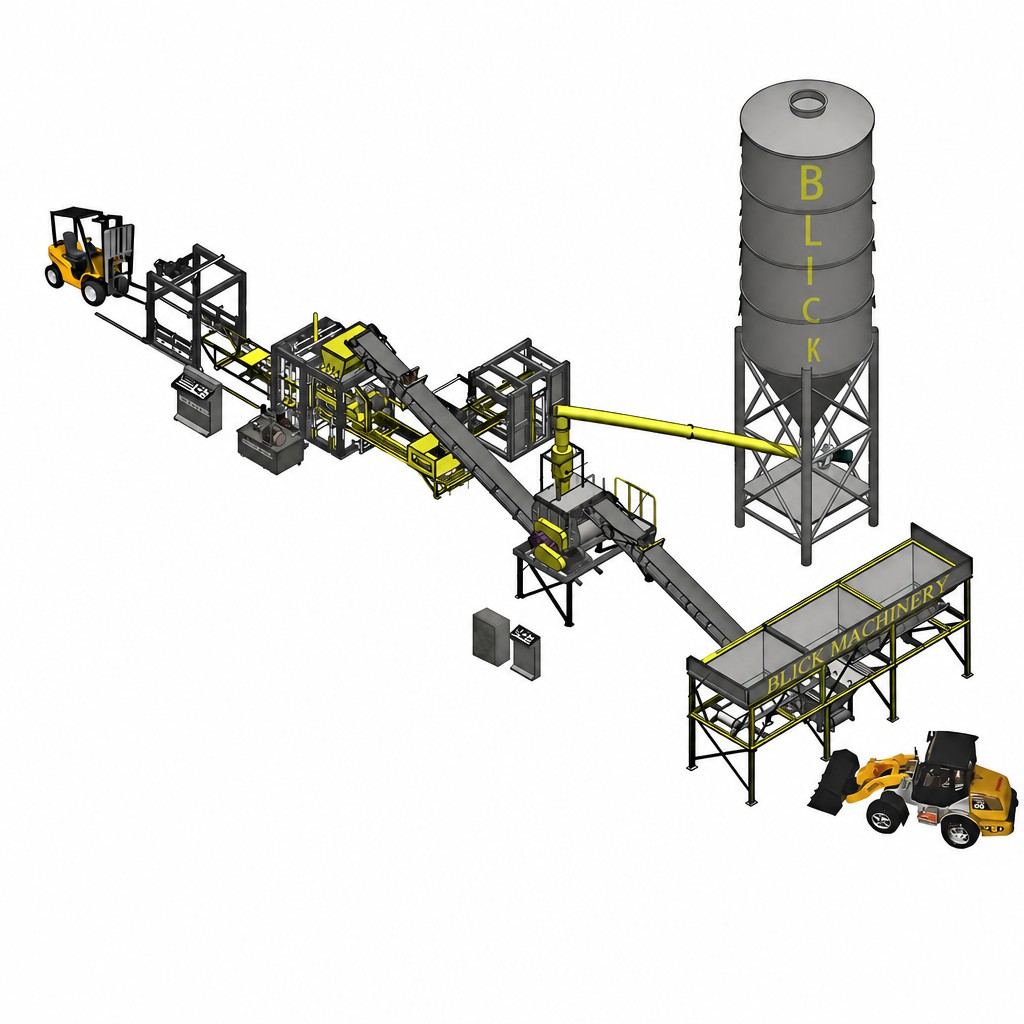
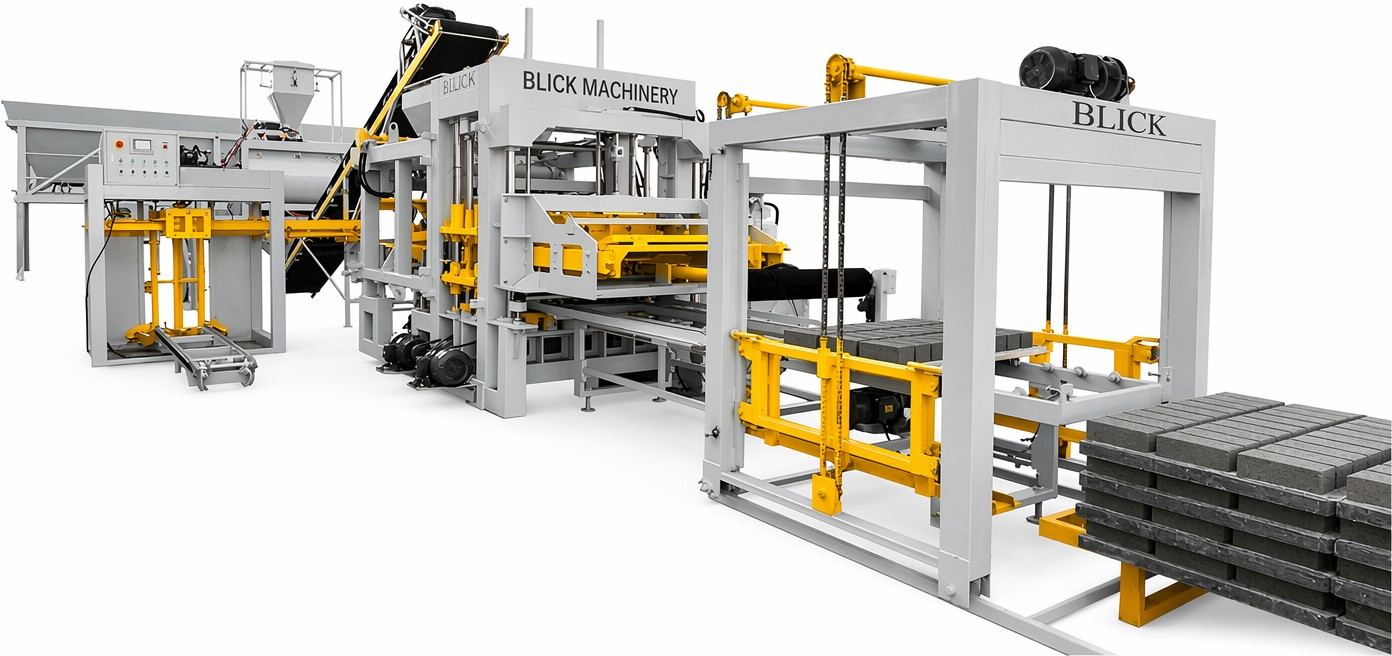
What does a complete block production line include?
Five stages handed over as one line: aggregate batching and dosing, mixing, hydraulic forming with pallet feed, pallet handling and stacking, and curing with optional packaging. The order also carries the flowsheet, foundation drawings, container loading plan, installation supervision, operator training and spare-parts list.
How many blocks per day can each tier produce?
Starter (4-40C) 3,000-3,500 blocks per day. Commercial (QT6-15) 8,500-10,000 hollow blocks per 8-hour shift. Industrial (QT10-15) 15,000-16,000 hollow blocks or 54,000-56,000 solid blocks per 8-hour shift. Figures are the forming machine's rated output for 400x200 hollow and 230x110 solid blocks.
What power supply does the line need?
The forming machine alone draws 9.6 kW (4-40C), 32.25 kW (QT6-15) or 50.6 kW (QT10-15) at 220 V or 380 V, 50 or 60 Hz. Add the mixer, conveyor, stacker and site lighting to that figure. The full site load is confirmed against your equipment list before shipment.
Can I start semi-automatic and upgrade to automatic later?
Yes, in stages. A 4-40C starter set establishes the yard demand; the automatic tiers add PLC control, pallet circulation and automatic stacking on the same material flow. The automatic lines are also modular: extra silos, colour dosing, a splitter and packaging can be added to the core press later.
Which raw materials can the line use?
Fly ash, slag, crushed construction waste and recycled aggregate, as well as a conventional cement-and-sand mix. On the automatic tiers the PLC stores more than 100 mix formulas, so switching material does not mean re-setting the line by hand.
Do you supply moulds for different block types?
Yes. More than 15 mould types are available across hollow blocks, solid blocks, pavers, curbs and interlocking shapes. One mould is supplied with the machine and additional moulds are quoted with the line, so the block range is fixed before the factory layout is drawn.
How long does installation take?
It depends on the tier and on site readiness, so it is stated in the project schedule rather than as a fixed number. What is fixed is the scope: mechanical installation supervision, commissioning through the first production run, and operator training on your own line.
How is a line priced?
Per project. The variables are the tier, the block range (which sets the mould count), the batching capacity, the degree of automation in pallet handling, and the site power arrangement. Send your target daily output and block mix for a configured quotation.